As an Amazon Associate, we earn from qualifying purchases. Some links on this site are affiliate links at no extra cost to you. Our recommendations are based on thorough research and editorial judgment.


Understanding Bass Guitar Tone Controls: EQ and Preamps

When we talk about understanding bass guitar tone controls, EQ and preamps play a vital role. EQ lets us adjust frequencies to enhance our sound—boosting lows for a punchy feel or mids for clarity. Bass amps usually have Bass, Mid, and Treble controls, and starting with a flat EQ helps us find our natural tone. Preamps add another layer, offering built-in EQ and preserving our sound quality. Let’s explore how these tools can shape our unique bass sound even further!
Key Takeaways
- EQ allows bass players to adjust specific frequencies, enhancing low end, mids, and treble to achieve desired tonal qualities.
- Preamps amplify the signal and often include built-in EQ, providing additional control over bass tone shaping before the amp.
- Utilizing flat EQ settings as a starting point helps evaluate the bass’s natural tone before making adjustments.
- True bypass in pedals preserves the original signal’s integrity, reducing tone degradation when effects are not in use.
- Multi-effects pedals combine EQ and compression, offering versatility and convenience for real-time tonal adjustments during performance.
What Is EQ and Why It Matters for Bass Guitar

You may be interested


Hey there! So, if you want to get the most out of your bass guitar, grasping the concept of EQ, or equalization, is super important. Basically, EQ lets us tweak specific frequency ranges to enhance our bass sound. Think of it like adjusting the ingredients in your favorite recipe—by dialing in the right frequencies, you can make your bass tone just right.
We typically focus on three main areas: low bass in the 80-120Hz range gives you that deep thump, mid bass around 120-200Hz adds warmth, and clarity near 800Hz helps your notes stand out. A simple way to start is by setting all your EQ controls to flat, which essentially gives you a clean slate to evaluate your sound. Once you’ve done that, you can start cutting out frequencies that make things sound muddy or boosting others for that clear tone you’re after. If you have an active bass guitar, you’ve got even more control at your fingertips to fine-tune your sound to fit any genre or setting.
Give it a try next time you’re jamming, and see how these adjustments can really change your vibe! And once you’ve nailed down the EQ, it’s worth exploring other aspects of your tone that work together with it. Using compressor pedals alongside EQ can help maintain consistent volume and enhance your overall bass tone.
Key Elements of Bass Amp EQ Controls

Hey there! So, if you’re looking to get the hang of EQ on your bass amp, you’re already on the right track. A standard bass amp usually has three main controls: Bass, Mid, and Treble. These let you play around with the sound across key frequencies to really find your groove.
Now, the bass range is where the magic happens, typically sitting between 40Hz and 400Hz. If you want that deep, rich tone, try turning up the low bass a bit, especially around 80-120Hz. You’ll notice a difference. And don’t forget about the mids—boosting that clarity around 800Hz can help your notes pop out in the mix.
Starting with the EQ at neutral—like all knobs at “12 o’clock”—is a great way to get a feel for your natural tone without any interference. From there, you can make adjustments as you see fit. Sometimes, it’s not all about boosting; cutting certain frequencies can make a world of difference. For instance, if your sound feels muddy, lowering some low-end frequencies can clear things up nicely, giving you a more defined sound.
For even more precise sound shaping, many bass amps include contour switches that help tailor your tone to specific music styles and venues.
Recommended Products

A studio-quality, 96 kHz/64-bit digital signal processor uses enhanced dithering technology and a low-jitter clock to deliver a warm, natural analog sound

UNCOMPROMISING BASS FOR LARGE HOME THEATER SYSTEMS - Featuring new 3XR Architecture that offers triple bass-producing surface area of a ported sub, this Descend DN15 Home Theater Subwoofer delivers low, impactful bass as loud as two 18” ported subs

𝗖𝗵𝗲𝘃𝘆 𝗦𝗶𝗹𝘃𝗲𝗿𝗮𝗱𝗼 𝗮𝗻𝗱 𝗚𝗠𝗖 𝗦𝗶𝗲𝗿𝗿𝗮 (𝟮𝟬𝟭𝟰-𝟮𝟬𝟭𝟴): Provides seamless integration with an OEM-style factory look for both Bose and non-Bose equipped vehicles. Also compatible with 2015-2019 Silverado HD and Sierra HD models. *Does not retain select factory features (see installation guide for details).
Specific EQ Adjustments for Different Genres

Hey! So, let’s chat about how we can tweak our bass guitar’s EQ settings to really capture the vibe of different music genres. Each genre has its own flavor, and with some thoughtful EQ adjustments, you can achieve those signature sounds that fit right in.
For example, in funk and R&B, you’d want to boost both the bass tones and the treble while keeping the mids flat. This gives you that punchy sound that makes you want to dance. Think about classic funk artists like Parliament, where the bass really drives the groove.
Now, when it comes to reggae, the key is all about enhancing those low frequencies with a nice boost in the bass. You can also use palm muting techniques to keep your sound crisp and clear. Picture the laid-back grooves of Bob Marley—it’s all about that deep, smooth bass you can feel.
Switching gears to rock, fresh stainless steel strings can amp up your sound, and adding a bit of overdrive really packs a punch. Here, you should definitely crank up the treble to ensure your bass cuts through the mix, much like the powerful lines you hear in Foo Fighters tracks.
Then there’s jazz fusion, where playing near the bridge helps bring out the mids and adds that distinct clarity. It’s about creating a clean, articulate sound reminiscent of artists like Jaco Pastorius. And if you’re using an active bass, tweaking your onboard EQ lets you fine-tune your tone even more—this is especially useful in genres like pop and metal to get that precise sound. The choice of pickup types and electronics also significantly shapes your tone, allowing further customization to fit your genre and playing style.
Recommended Products
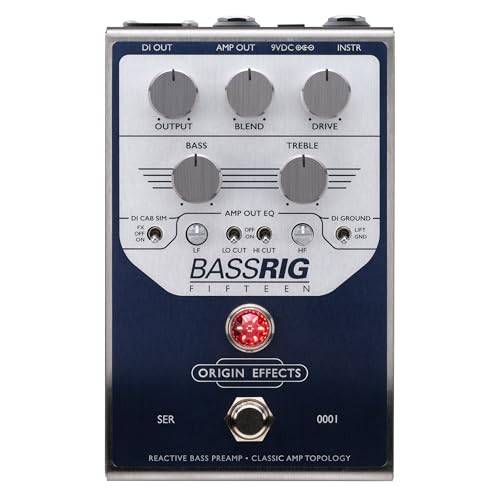
Faithfully recreates the sound and feel of the B-15 amp

Bass Guitar Preamp Pedal with BLK/TWD Switch

Takes the floating ambient tones of our Dispatch Master to the next level while still keeping it user friendly and refined
Top EQ Mistakes Bassists Make and How to Fix Them
You know, many bassists stumble into some common EQ mistakes that can really muddy their sound and hold back their creativity. One of the big culprits is over-boosting those bass frequencies. It might feel good to turn it up, but it often leads to a muddled mix. Instead, try cutting a bit of that low end. For instance, removing a few dB from the lowest frequencies can make your sound punchier and clearer.
Another area we often overlook is the midrange frequencies—they’re crucial for making your bass stand out in a mix. If you give those mids a gentle boost, you’ll find your tone cuts through even when you’re playing with a full band. Starting with flat EQ settings gives you a clean slate, which is great because it lets you make better adjustments depending on the venue or the style of music.
Also, don’t fall into the trap of only messing with your amp settings. Make use of your onboard EQ controls; this can really expand your tonal options! And remember, finding the right balance between gain and drive is key. You want that nice gritty sound without crossing over into distortion. Using equipment with ergonomic handles can help you comfortably transport your gear to gigs, ensuring your tone controls stay intact.
Recommended Products

Delivers powerful distorted bass tones with punch and clarity.

Two Stereo Reverbs available at once, each fully pannable in the stereo field

EFFORTLESS CONTROL: The ME-90B offers easy access via the classic BOSS ME interface, enabling fast stompbox-style operation. Each effect category has independent parameter knobs for instant tone tweaks. Manual mode allows footswitch control of each category, while Memory mode recalls 36 custom setups.
Starting With a Flat EQ – Why It Matters
Hey there! Let’s chat about starting with a flat EQ and why it’s so important for shaping your bass tone. When you set all your EQ settings to a neutral position, you get a true picture of how your bass and amp actually sound. It’s like hitting the reset button – this way, you can really pinpoint which frequencies need a little boost or a soft touch without going overboard.
Think of it this way: if you’re listening to your bass with all the knobs at zero, it should still sound pretty good. If it doesn’t, you might want to consider upgrading your equipment. For example, when I play with my band, I first adjust my EQ to flat and then play a few notes to really hear what my bass sounds like in its natural state. From there, I might add a touch of low-end for warmth or cut some mids if it sounds too muddy.
Starting flat really helps make the whole tone-shaping process smoother. Once you’ve found that baseline sound, tweaking the EQ to match your personal style becomes way easier. So, let’s explore those frequency adjustments next and see how you can dial in the perfect tone for your playing! Using an amp with tone control options can greatly enhance your ability to fine-tune these adjustments.
How to Explore Advanced EQ Options: Pedals and Tools
Hey, have you ever thought about how advanced EQ options can open up a whole new world of tonal possibilities for your sound? One great way to tap into that is by using EQ pedals. For instance, graphic EQ pedals let you boost or cut specific frequencies, giving you precise control over your tone. This can be a game-changer, especially if you play an active bass with an onboard preamp like Aguilar, which offers multiple EQ bands specifically for fine-tuning your sound.
When you start experimenting with different EQ pedals, remember that they can interact differently with your amp and bass settings. If you make too many changes, you might end up with a muddied sound. A good example to try is the Boss graphic EQ pedal; it allows for real-time adjustments during your performance, helping you dial in the perfect tone on the fly.
It’s all about finding the right combinations and not being afraid to experiment with modulation effects, too. These can really enhance your sound and tailor it to fit your unique style. Next, let’s see how different EQ settings can affect your overall tone and playing experience! Additionally, considering pedals with true bypass functionality helps maintain the purity of your original signal when the pedal is disengaged.
Recommended Products

CFX Stereo Sampling faithfully reproduces the sound of Yamaha's flagship CFX Full Concert Grand.

Delivers 500 watts of all-analog power for dynamic and punchy bass tones.

500W Bass Amplifier Head with Compress
How Do EQ and Preamps Work Together to Enhance Bass Tone?
When it comes to crafting the perfect bass tone, understanding how EQ and preamps work together is super important. Think of EQ, or equalization, as a way to flavor your bass guitar’s sound by tweaking different frequency ranges—like Bass, Mid, and Treble. For instance, if you want a punchy low end, you could boost the bass frequencies a bit to really make your notes pop.
Now, preamps are where the magic starts happening. They amplify your bass signal before it hits the amp, and many come with their own EQ controls, giving you even more tools to shape your sound. For example, if your signal feels too harsh, you can cut some of the treble in the preamp to smooth things out. Additionally, integrating multi-effects pedals that include EQ and compression can greatly enhance tonal variety and performance flexibility.
Recommended Products

4 x 5" Bass Combo Amp with 5-band EQ

Inspired by the iconic 1073, featuring hand-wired, Class A components for authentic analog sound.

The Katana-500 Bass Head raises professional bass amplification to the next level with advanced BOSS technology
Frequently Asked Questions
How Does String Choice Affect My Bass Guitar Tone?
String choice dramatically affects our bass guitar tone. Different string materials, gauges, brands, and even age can change our sound’s warmth, brightness, and playability. We should experiment with various options to find what suits us best.
What Role Does Pickup Position Play in EQ Settings?
Think of pickup position like a painter’s brush strokes on a canvas. We can adjust placement effects, discovering tonal color variations, while understanding frequency response impact helps us refine our sound with clever position adjustment techniques.
Can an EQ Affect My Bass’s Sustain and Dynamics?
Yes, adjusting our EQ settings can considerably affect our bass’s sustain effects and dynamic range. It shapes our tonal characteristics, allowing us to emphasize certain frequencies for a richer, more responsive sound. Let’s explore this together!
How Do Different Genres Influence EQ Settings?
Different genres certainly influence EQ settings. We tailor genre characteristics with genre-specific techniques, using genre tone examples like funk’s punchy lows or rock’s midrange presence. Mixing styles, we blend these elements to create distinct sounds.
What Are Common EQ Settings Used by Famous Bassists?
Many famous bassists have signature sounds that reflect their genre variations. We’ve noticed preferences like flat mids for funk, boosted lows for rock, and EQ curves tailored for tone shaping, creating unique sonic identities.


